
Journal · Process
The Art of the Custom Build: From Concept to Key
If this topic connects to a larger project, you can also review our custom home builders in Toronto, major home renovations in the GTA, and the Annual Home Maintenance Plan for ongoing protection.
Luxury custom homes succeed when design, permitting, budgeting, and construction are managed as one system. This guide explains each phase and where timelines are most often won or lost in Toronto and the GTA.

Phase 1: Discovery and Brief
We define budget range, site constraints, lifestyle goals, and must-have rooms first. This avoids expensive redesign loops later and aligns architecture with real construction parameters.
Phase 2: Concept and Design Development
Concept options establish massing, flow, and facade direction. During development, structural logic, mechanical planning, and finish strategy are integrated so design intent remains buildable.
Phase 3: Permit and Pre-Construction
Ontario permitting timelines vary by municipality and scope. Accurate permit sets, consultant coordination, and proactive responses reduce approval delays and protect schedule certainty.
Phase 4: Construction Execution
Sequencing, procurement, and quality control are the backbone of performance. Site coordination protects both cost and schedule, especially where custom millwork, structural steel, and high-spec systems intersect.
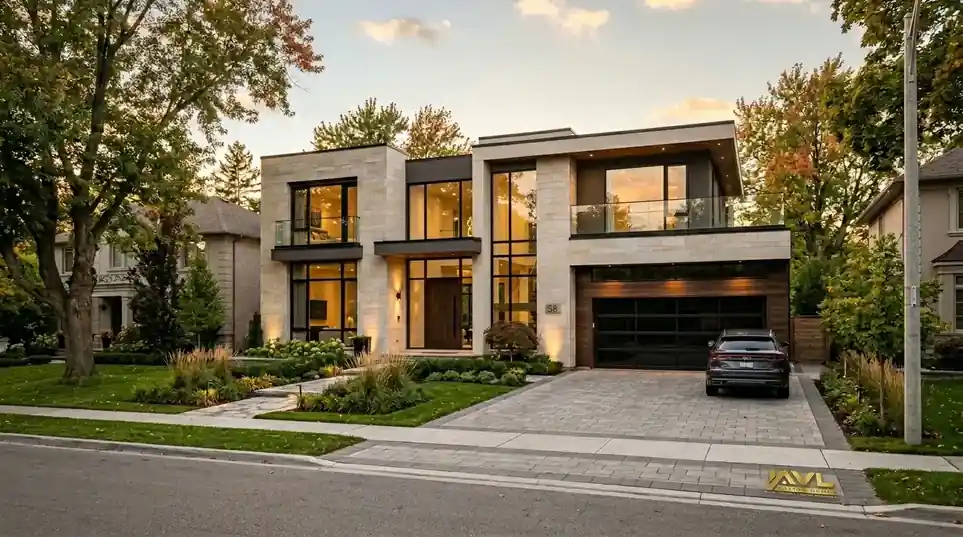
Phase 5: Commissioning and Handover
The final phase includes system verification, deficiency closeout, and owner orientation. Proper handover documentation creates long-term maintenance confidence and preserves asset value.
If you are planning a custom project, compare this process with our custom home service framework or request a scoped consultation through contact.
What separates smooth builds from delayed ones
Most custom-home delays trace back to decisions made before shovels hit the ground: incomplete geotechnical review, vague finish specifications, or permit sets that do not match how the home will actually be built. In Toronto and the GTA, municipal review cycles vary by ward and scope — heritage districts, ravine setbacks, and tree protection bylaws can add weeks if they are treated as afterthoughts.
Design-build teams that own both drawings and execution can resolve conflicts in real time. When architecture, structural engineering, mechanical sizing, and procurement live in separate silos, change orders multiply. A coordinated team aligns ceiling heights with duct paths, window sizes with structural spans, and millwork lead times with drywall schedules before pricing is finalized.
Budget realism matters as much as aesthetics. Luxury finishes are easy to specify on paper; maintaining air sealing, drainage planes, and thermal continuity while delivering those finishes is where builder experience shows. Compare our Richmond Hill custom home building guide for regional cost and permit context, and our renovation decision guide if you are weighing a major refresh against a new build.
Owner checklist before you commit
- Confirm lot constraints: zoning, easements, servicing, and stormwater discharge.
- Define must-have rooms and realistic square footage — not magazine spreads.
- Request a phased budget with contingency for existing conditions.
- Ask how permits, inspections, and warranty documentation will be handled.
- Verify WSIB, licensing, and insurance before contract signing.
Custom builds succeed when every phase has a clear owner, a clear deliverable, and a clear gate before the next phase starts. That discipline is what turns “concept to key” from a slogan into a schedule you can actually live with.
Commissioning and long-term care
Handover is not the end of the relationship. HVAC balancing, smart-home programming, and warranty documentation should be completed before final payment milestones. We provide owner orientation on maintenance intervals — HRV filters, sump pumps, exterior caulking — so your new home stays within spec.
Many owners pair a custom build with our Annual Home Maintenance Plan for thermal scans and seasonal visits. Early baseline photos make it easier to distinguish normal settlement from issues that need intervention.
Whether you are on a vacant lot or replacing an aging home, the same phase gates apply: brief, concept, permit set, build, commission. Skipping a gate to “save time” almost always costs more later.
Questions to ask any builder
Ask for recent projects in your municipality, not just portfolio photos. Request references from clients whose homes are two to three years old — warranty and callback history matters. Confirm who holds the contract, who supervises site daily, and how change orders are priced in writing before work starts.
Luxury custom homes fail quietly when communication fails loudly. Weekly written updates, photo logs, and a single decision-maker on the owner side keep momentum and prevent “surprise” selections that blow budget.
From first sketch to key handover, the goal is one coherent story: a home that matches how you live, meets Ontario code, and stays maintainable for decades. That is the standard we hold every AVL custom build to across the GTA.

Written by Ali Vaez
Founder & Principal Builder, AVL Custom Homes Inc.
BSc and MSc in Civil Engineering (Structural Engineering). Building since 2004 (outside Canada), serving the GTA since 2014, 17+ homes delivered.
Published: 2026-01-15 · 6 min read · 920 words
